On Freedom: Four Songs of Care and Constraint by Maggie Nelson
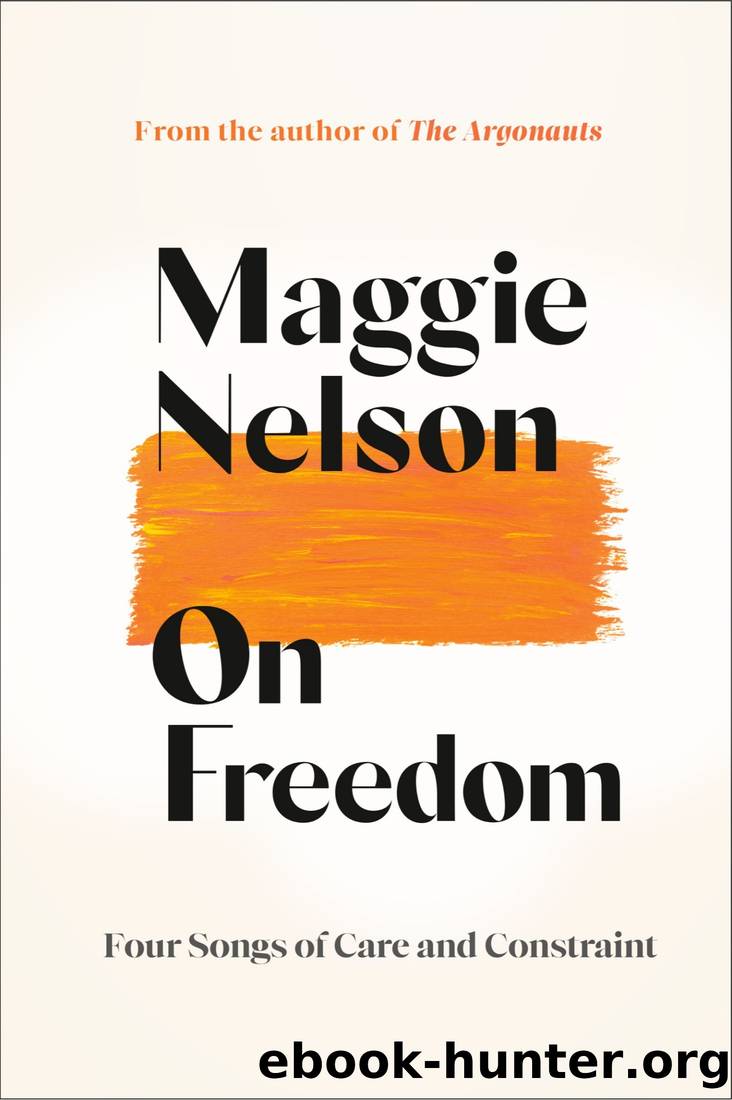
Author:Maggie Nelson [Nelson, Maggie]
Language: eng
Format: epub
ISBN: 9781644450628
Google: UXMczgEACAAJ
Amazon: 1644450623
Publisher: Graywolf Press
Published: 2021-09-06T23:00:00+00:00
THE BLONDES
The literary genre of the âaddiction memoirâ has tended to be very white, and, even when itâs not, very male.9 The reasons behind such a situation are numerous and complex, and likely have something to do with white writersâ propensity to frame their experience as detachable from socioeconomic-political forces that tend to be glaringly obvious to others; such a propensity leads to the creation of works more easily classifiable as âaddiction memoirs.â10 But while white addiction narratives may at first glance appear to be devoid of racial consciousness, upon closer inspection, most appear saturated with anxieties about whiteness, as well as with strategic (if unconscious) deployment of racialized tropes that âsurface endlessly when one begins to look carefully,â as Toni Morrison has it in Playing in the Dark.
In the case of Crack Wars, one doesnât even have to look past its title, whose aforementioned bait and switch highlights its own chaotic symptomology. For whatever horrors the transgressions of Emma Bovary/EB/Ronell may provoke, they fade in comparison with the brutal state-sponsored persecution and punishment of Black people, including Black mothers, that characterize the War on Drugs.11 Yet whatever unease, revulsion, and anger Iâve felt on this account has, over time, deepened my interest in Crack Wars. For by throwing EB into the combustible cauldron of the âwar on drugs,â Ronell invites certain questions about the relationship between white girls and the racialized construction of drugs and transgressionâquestions that go mostly unanswered in Crack Wars, but which crack open the door to further inquiry.
Given their lack of access to public space and independent funds prior to the 1960s, many white women used drugs as patientsâeither as inpatients in residential settings (as was the case with Kavan), or by scamming drugs from medical settings (cf. the infamous pill-popping milieu memorialized in Jacqueline Susannâs Valley of the Dolls).12 But as white women hit the street market, their literary accounts began to reflect the racialized dynamics that have long shaped the criminalized world of âdrugs.â Some evidence a fetishizing enthusiasm, as in Ann Marloweâs chiseled, chilly memoir How to Stop Time: Heroin from A to Z: âCopping feeds the middle-class fascination with the street. Finally youâre out there with the scary people, not cowering from them, but joining them.â (The combination of Marloweâs enthusiasm for being âout there with the scary peopleâ and her unabashed elitismâshe was a Wall Street exec by day, Alphabet City crawler by nightâis often perfectly revolting, with the debatable virtue of advertising that which others tend to euphemize.) For white girls with more social conscience and savvy, such as Michelle Teaâs first-person narrator in the autofictive Black Wave, there is more self-awareness and political discomfort, both of which are ultimately mowed over, for better or worse, by the power of the drug: âMichelle wondered for a second if there were diseases to be caught from the burned glass pipe of a career crackhead, but she had learned that fearful questions in such situations could lead to racism, to classism, to all sorts of unevolved and judgmental states of mind, and so one did not think too hard.
Download
This site does not store any files on its server. We only index and link to content provided by other sites. Please contact the content providers to delete copyright contents if any and email us, we'll remove relevant links or contents immediately.
| Anthropology | Archaeology |
| Philosophy | Politics & Government |
| Social Sciences | Sociology |
| Women's Studies |
Cecilia; Or, Memoirs of an Heiress — Volume 1 by Fanny Burney(32558)
The Great Music City by Andrea Baker(32018)
Cecilia; Or, Memoirs of an Heiress — Volume 2 by Fanny Burney(31956)
Cecilia; Or, Memoirs of an Heiress — Volume 3 by Fanny Burney(31941)
We're Going to Need More Wine by Gabrielle Union(19045)
All the Missing Girls by Megan Miranda(16023)
Pimp by Iceberg Slim(14506)
For the Love of Europe by Rick Steves(14121)
Bombshells: Glamour Girls of a Lifetime by Sullivan Steve(14073)
Talking to Strangers by Malcolm Gladwell(13370)
Norse Mythology by Gaiman Neil(13363)
Fifty Shades Freed by E L James(13239)
Mindhunter: Inside the FBI's Elite Serial Crime Unit by John E. Douglas & Mark Olshaker(9339)
Crazy Rich Asians by Kevin Kwan(9290)
The Lost Art of Listening by Michael P. Nichols(7506)
Enlightenment Now: The Case for Reason, Science, Humanism, and Progress by Steven Pinker(7311)
The Four Agreements by Don Miguel Ruiz(6763)
Bad Blood by John Carreyrou(6621)
Weapons of Math Destruction by Cathy O'Neil(6279)
